

Tuning the assembly and proving it
Rigidity versus flexibility: cage or bowl?
The final shape is not guaranteed: it depends on the rigidity of the ligand's arms. This is the central result of the study, summarized below.
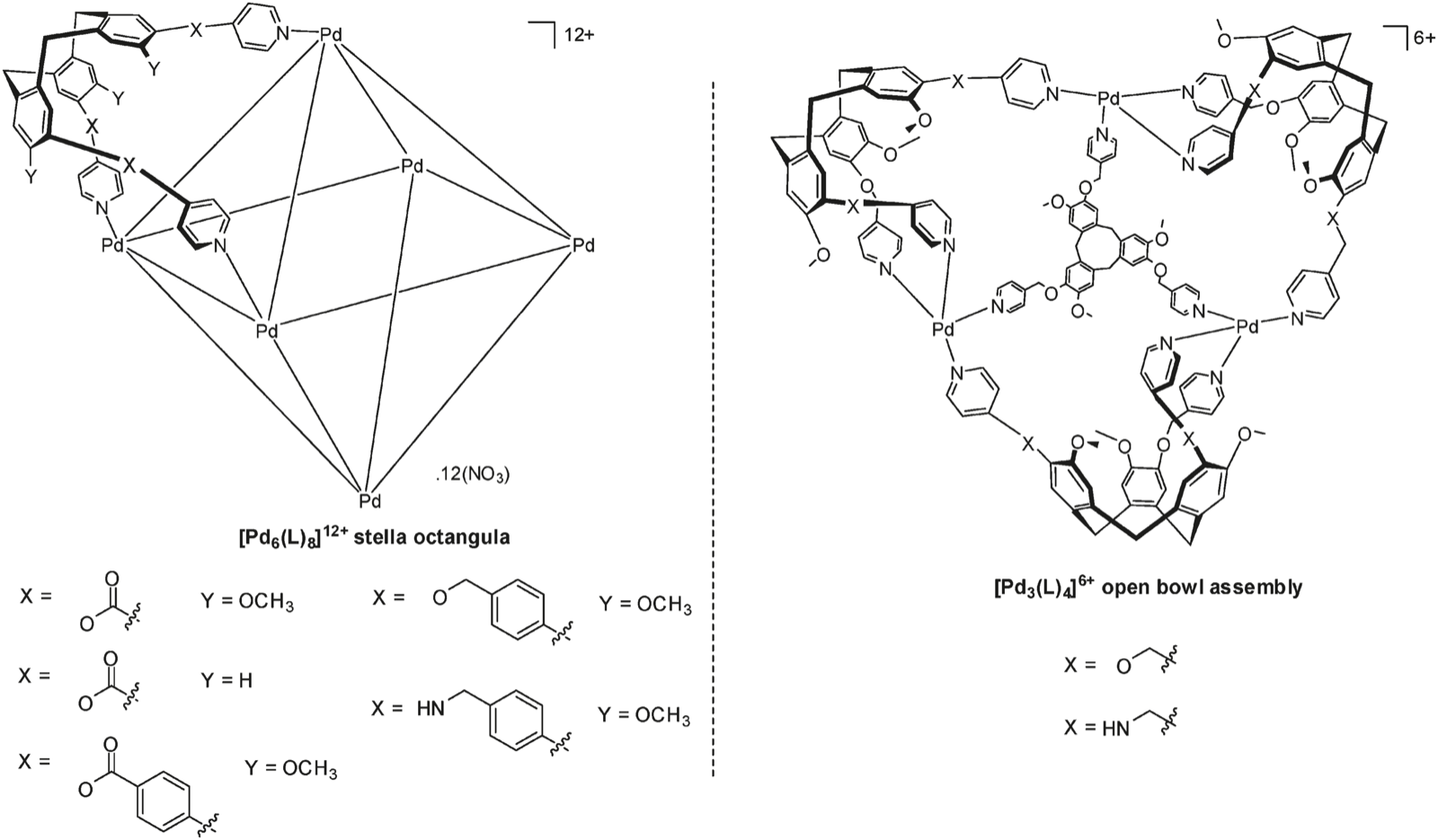 Scheme 3. Left, the closed stella octangula [Pd₆L₈]¹²⁺ (rigid arms); right, the open bowl [Pd₃L₄]⁶⁺ (flexible arms). The linker X changes everything.
When the arm connecting the bowl to the pyridyl is rigid — an ester bond, or a long, well-extended aryl arm — the eight ligands settle neatly onto the faces of the octahedron: you get the closed cage [Pd₆L₈]¹²⁺. Six of the seven ligands tested behave this way, which confirms the generality of the stella octangula.
But two ligands have a flexible linker: an ether bridge –O–CH₂– or an amine –NH–CH₂–. An arm that bends can no longer impose the right orientation. The system then switches to a smaller assembly, [Pd₃L₄]⁶⁺: three Pd, four ligands, an open bowl (superbowl) instead of a closed cage.
   rigid arm    (ester, aryl)    ->  [Pd6 L8]12+   (closed cage, 8 windows)
   flexible arm (ether, amine)   ->  [Pd3 L4]6+    (open bowl, superbowl)
The message is profound: in self-assembly, the shape of the product is written in the flexibility of the components. One degree of freedom too many in an arm, and the octahedron gives way to a bowl. In the solid state, these bowls actually pair up two by two through weak hydrogen bonds, re-forming a structure close to a flattened stella octangula: nature recovers the same symmetry by another route.