

Metal-directed self-assembly
The principle of supramolecular self-assembly
Supramolecular chemistry studies what molecules do together, beyond the covalent bond: recognizing each other, encapsulating, assembling. Its most spectacular idea is self-assembly: you mix the right components and let the system build itself, guided by thermodynamics.
Here, two building blocks are enough. On one side, a tripodal ligand derived from cyclotriveratrylene (CTV): a shallow bowl-shaped molecule whose rim carries three identical arms, each ending in a 4-pyridyl group (an electron-donating nitrogen). On the other, a metal cation, palladium(II). Pd(II) is square planar: it accepts only four bonds, arranged at 90°. It is a rigid, directional corner. Each pyridyl nitrogen coordinates to a Pd, and each Pd links several ligands together.
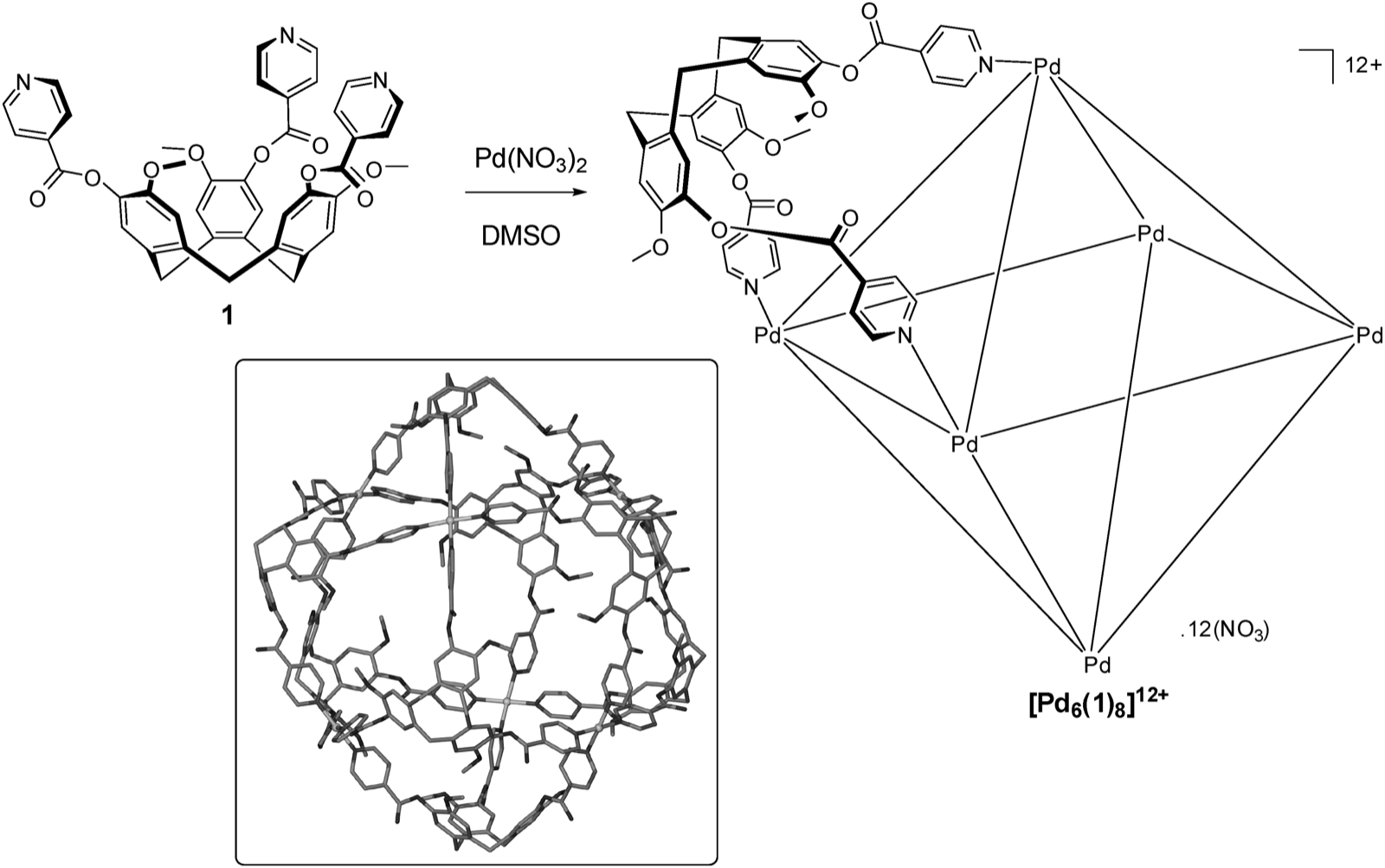 Scheme 1. Tripodal ligand 1 reacts with Pd(NO₃)₂ in DMSO and spontaneously forms the cage [Pd₆(1)₈]¹²⁺. Inset: its actual crystal structure.
Why do we get a single assembly rather than a disordered mixture? Because the pyridyl–Pd coordination bonds are reversible: they constantly form and break. The system explores a multitude of combinations, then gets trapped in the most stable one — the one that saturates all valences without geometric strain. This is self-correction: misplaced bonds undo themselves, like a jigsaw puzzle that solves itself when you shake the box.
The result encodes the information contained in the shape of the building blocks (the angle of the bowl, the rigidity of the arms, the angle imposed by the metal), without ever having to assemble anything atom by atom. Remember the equation: information in the components + reversible bonds = a single architecture, obtained in one step.