

From Classical Control to an Autonomous Description
Work, a Puzzle at the Quantum Scale
In thermodynamics, a driven system is described by a time-dependent Hamiltonian, Ĥ_S(t). Moving a piston, switching on a field: it all comes down to varying Ĥ_S(t) over time. It is convenient, and for a classical system it is perfectly justified.
At the quantum scale, this description hides a problem. Varying Ĥ_S(t) assumes an external agent that manipulates the system — a control field. Yet producing and steering this field costs energy and dissipates entropy, often on scales far larger than the quantum process itself. This cost is simply absent from the model.
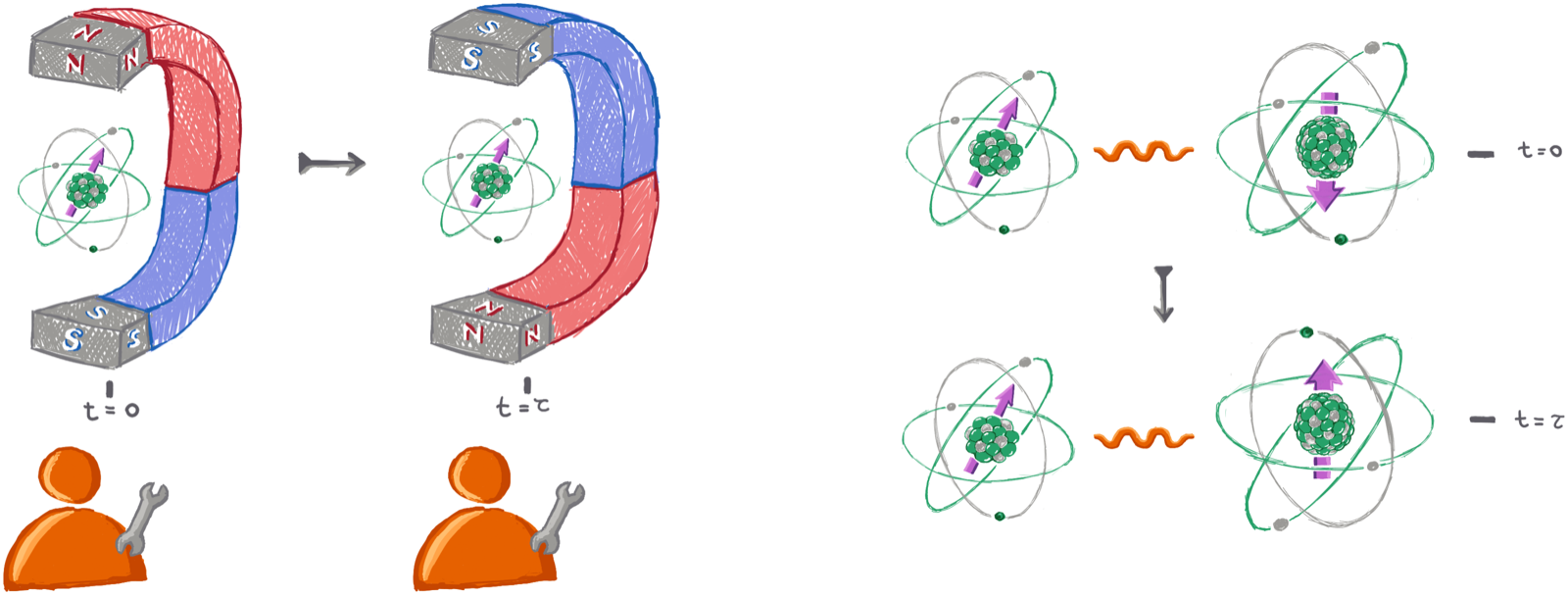 Fig. 1. Left: the usual description. A classical agent (with its wrench) flips an external magnet to drive the qubit; the cost of this control is ignored. Right: the autonomous description. The controller itself becomes a quantum system coupled to the qubit.
The consequence is genuine confusion about what "quantum work" is. Several definitions coexist and contradict one another: ergotropy (the energy extractable by unitary operations), the cyclic work of heat engines, or the two-projective-measurement (TPM) scheme, which requires a measurement before and after the process. Each has its flaws, and the semiclassical treatment prevents a closed energy accounting.
   Ĥ_S(t)  =  driving Hamiltonian                (time-dependent)
   problem :  the cost of external control       (not accounted for)
           :  can exceed by several orders       (the scale of the system)
Hence the fundamental question raised by the paper: if we refuse to treat the controller as an external agent, and include it in the quantum description, does work finally become a well-defined quantity?